
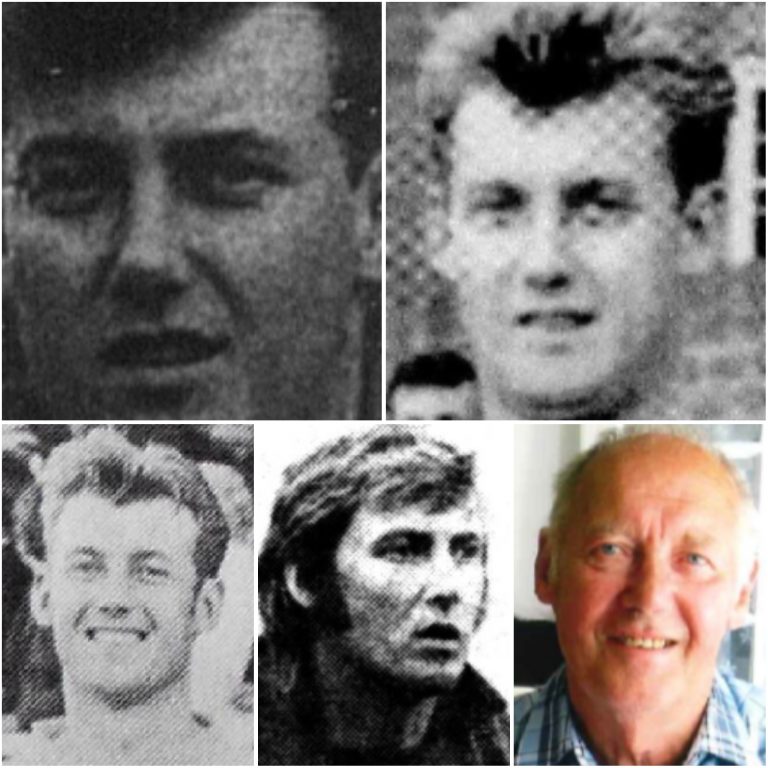
In November, we were sad to hear of the passing of former Bromsgrove Rovers keeper Chris Hooper, at the age of 83. Rovers historians, Michael Tovey and Graham Reynolds, have penned the following tribute to Chris…
Chris was born on 11 March 1942 and, as a child, lived in Kings Norton. On leaving school, he signed for Birmingham City, first playing in the Fourth team in October, 1959, as a 17-year-old. He soon progressed to the Thirds and was part of the team that lifted the Warwickshire Combination Camkin Cup in September 1960, beating West Bromwich Albion 3-1 at St Andrews. Sadly, misfortune was around the corner.
In November, 1960, First team keeper Johnny Schofield fractured his skull and Colin Withers, who himself was battling injury, was promoted from the Reserves to replace him. Chris was an absolute shoe-in for reserve team football, but it was not to be. In a match just three days later, he fractured his ankle in two places, which required a pin to be inserted in the ankle to keep it straight, and that unfortunately was the end of his dreams of a future in the professional game. He reflected some years later; “Gil Merrick was the
manager at Blues then, but I never found out whether or not I could have made it.”
Following a long and arduous recovery, Chris was loaned to Bromsgrove near the start of the 1961/62 season, his first appearance being for the Reserves against Walsall Wood in the Worcestershire Combination on 19 August 1961. After the Rovers exited the FA Cup at the hands of Sankey’s and then lost their unbeaten league run to Brierley Hill Alliance a week later, Joe Wainwright decided to ring the changes and Chris was promoted to the First team.
It was a bold move by the Manager as Jack Lewis had played 170 out of a possible 171 matches since he joined the club. Chris’ debut came against Evesham United on 14 October 1961. It can’t be described as a dream debut as the Rovers lost 3-1, with Chris mishandling a corner and gifting Evesham one of the goals. While Joe also looked at Tony Avery as a potential replacement, he must have been convinced of Chris’ talents and by the end of the season he was the regular first choice keeper. The loan arrangement was soon made permanent and Chris became the undisputed number one, a role he kept until 1974.
Chris’ consistent performances no doubt greatly helped the Rovers as they managed a series of top half finishes in the first half of the decade. In the summer of 1965, it seemed likely that Chris would move on, with Rovers receiving approaches from Stourbridge, Dudley and Nuneaton Borough; there manager Fred Badham even stating; “I shall probably be signing Chris.”
However, in the end, Chris decided to remain at the Victoria Ground. His loyalty to the club was then without question. Speaking in 1970, he said; “I had an offer from Walsall and from other Southern League clubs. But I have been happy at Bromsgrove – the soccer is good, so are the amenities.”
Throughout the rest of the 1960s and into the 1970s, Chris missed very few matches. This was made even more remarkable as it was a period when the Rovers were playing a huge number of games each year, with the team playing in the Midland Floodlit League and the Camkin Cup in addition to the usual competitions. In 1968/69, he clocked up 69 appearances, bettering that in 1970/71 with 70. No one ever played more games in a single season for the Rovers than Chris did that year.
Chris played in all the cup finals Rovers reached in the late 1960s – the one that probably gave him the most satisfaction would be the 1968/69 Camkin Cup final. When speaking of the strikers he most admired during his career, Chris mentioned Ron McDermott of Bilston, Chic Bates of Stourbridge and Peter Wassall of
Kidderminster.
Wassall was an amazing goal scorer for the Harriers, notching a club record 65 goals in the 1968/69 season and it was the Harriers who the Rovers faced in that Camkin Cup final. With the tie level at 3-3 in the last minute of extra time in the second leg, Bobby Thomson upended Brendan Wassall and Kidderminster were awarded a penalty. As the Worcester Evening News reported; “Peter Wassall took the penalty and blasted the ball to his right, but Hooper with a miraculous dive caught it cleanly and cleared.” The save gave the Rovers a share of the trophy – no penalties in those days.
By the turn of the decade, he had long surpassed Frank Skitt’s record for most appearances by a goalkeeper and was granted a testimonial by the club. A West Midlands League XI was to take on a Midlands All-Star XI at the Victoria Ground on 16 December 1970, but the match was called off at the last minute as electricity authorities couldn’t guarantee power for the floodlights! This was the second time Chris’ testimonial had been postponed, the weather putting pay to it the season before.
The match did eventually take place in January, 1971. The All-Stars side included an array of Blues players, including Malcolm Beard who had been a teammate of Chris’ from his time at St Andrews, as well as former England international Peter Broadbent, who had signed for the Rovers two months earlier. The West Midlands XI included his old adversaries Bates and Wassall, alongside current teammates Mick Gwynne, John Wood and Brian Taylor. A crowd of 1,500 turned out to see the All-Stars triumph 6-5. The match raised £450 for Chris, a very tidy sum back in 1971 – probably worth around £9,000 in today’s money!
Season 1971/72 saw Chris complete 150 consecutive appearances for the club – a run which ended at 156 – and the following year he broke Arthur Wainwright’s all-time appearance record. He was awarded the ‘Player of the Year’ trophy at the 1972/73 end of season awards at the Perry Hall Hotel and, in August 1973, he played his 600th game for the Rovers, where he fittingly kept a clean sheet in a 0-0 draw with Kidderminster.
But his time at the club was drawing to a close. He was by now struggling with spinal arthritis and the 1974/75 season turned out to be his last. Dudley Hicklin had replaced him as first choice keeper mid-way through the campaign, but Chris continued to play for the Reserves. In a superb gesture and tribute, he was recalled to the First team for the final league game of the season. And at the Victoria Ground on 22 April 1975, nigh on 14 years after his debut, he signed off with a 3-2 victory over Milton Keynes City.
By the time he hung up his gloves, he had made 686 recorded first team appearances – a number which is no doubt a few shy due to information that has been sadly lost to time – and all-told, including friendlies, testimonials and reserve team games he would have represented the club close to 750 times.
It can’t be overstated what a wonderful player Chris was for the Rovers. It is probably best summed up in comments made by his teammate Alan Craddock in the Victoria Ground Story book; “Chris was the finest goalkeeper playing in non-league football in that period. He was a great shot-stopper, and like all outstanding goal keepers was very courageous and sustained many bad knocks through diving at the feet of oncoming forwards. Chris was as hard as nails as many opposing attackers found out when they bounced off Chris when they tried to shoulder charge him.”
The respect in which Chris was held was also shown in 1977, when the club put on a benefit game for him. He had been struggling with the arthritis which had ended his career, and funds from this game went to help fund twelve months of intensive treatment to help with his ailment.
“It was the opinion of the directors that Chris should not think he has been forgotten by Bromsgrove Rovers,” said Secretary Sid Cross at the time. “He was a very loyal player and we hope that we have been of some assistance.”
After his retirement, Chris remained a keen follower of both the Rovers and Bromsgrove Sporting, and he often attended matches up until the last few years. He passed away on 2 November 2025.
Chris Hooper, Bromsgrove Rovers’ greatest goalkeeper, 1961-1975. 686 appearances. Second on the all-time appearance list, behind Shaun O’Meara.